Authentic Japanese Cattle

WagyuJapan Logo

Introducing the exquisite taste of globally acclaimed Wagyu

The tenderness and delicate flavor of Wagyu is highly sought after in Japan, where cuisine emphasizes the natural taste of ingredients. To meet this demand, Japan has refined its production technologies. The rest of the world, more accustomed to more textured red meat, has been pleasantly surprised by Wagyu’s unique texture—a new style of beef that leaves a lasting impression. As a relatively rare commodity, Wagyu has the potential to enhance global food cultures and bring significant change.

Wagyu is any of four Japanese breeds of beef cattle —

Japanese Black
Japanese Black
(Kuroge Washu 黒毛和種)
Japanese Brown
Japanese Brown
(Akage Washu 赤毛和種)
Japanese Polled
Japanese Polled
(Mukaku Washu 無角和種)
Japanese Shorthorn
Japanese Shorthorn
(Nihon Tankaku Washu  日本短角和種)

Lovingly nurtured Wagyu

Each Wagyu cattle is given dedicated time and attention by feeding specialists in Japan’s vast open spaces. They are raised in a well-managed environment with a carefully designed diet of high-quality grains, rice straw, hay, wheat, and bran to ensure they are healthy and produce great-tasting beef. The cattle sheds are kept in immaculate condition to avoid stressing the delicate cattle, sometimes including soothing music and regular massages, to ensure their comfort and proper blood flow throughout the cattle. Stress can negatively impact meat quality. Wagyu cattle are bred with human compassion and attention. Outstanding production technologies and the pride of the master in pursuit of perfect Wagyu result in a superior quality found nowhere else in the world.

STRESS-FREE Environment

Listening music and taking massage
Cow drink beer
Drink beer

The melt-in-your-mouth texture

One of its most prominent characteristics is the beautiful white patterns known as marbled meat or  ‘Shimofuri 霜降り’ in Japan which are distributed through the muscle fibers. This fine texture gives Wagyu its extremely tender, melt-in-your-mouth quality. Wagyu is also renowned for its sweet, full-bodied aroma, known as ‘Wagyukoh 和牛香’ or beef aroma. When cooking, Wagyu emits an aroma reminiscent of coconut or fruit, enhancing its great taste. The flavor of Wagyu not only satisfies the taste buds but also engages all five senses, with the potential to significantly transform beef cuisine worldwide.

SHIMOFURI

Wagyu – Refined by Japanese culinary tradition

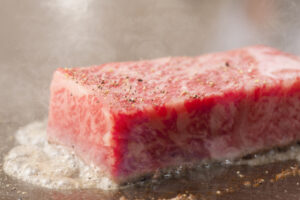
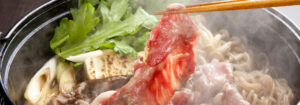
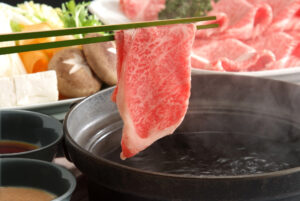
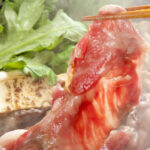
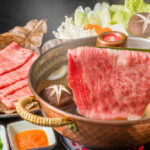
From Teppanyaki to Sukiyaki and Shabu-Shabu, Japanese cuisine offers a variety of dishes that highlight the tenderness and flavor of Wagyu. Teppanyaki draws out the full flavor of the ingredients simply, while Sukiyaki and ShabuShabu emphasize the delicate flavor and melt-in-your-mouth texture of thinly sliced beef. Japanese food culture, which values the natural flavors of ingredients, has refined Wagyu into the exceptional beef it is today. Unrivaled in taste, Wagyu is now gaining popularity worldwide as a luxury ingredient.
Teppanyaki
Teppanyaki
Sukiyaki
Sukiyaki
Shabu-Shabu
Shabu-Shabu

Wagyu Meat Grading System

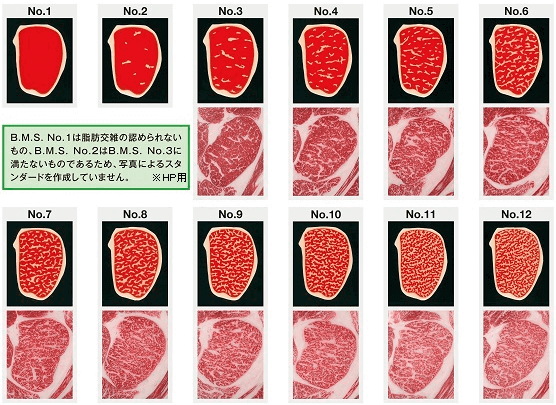
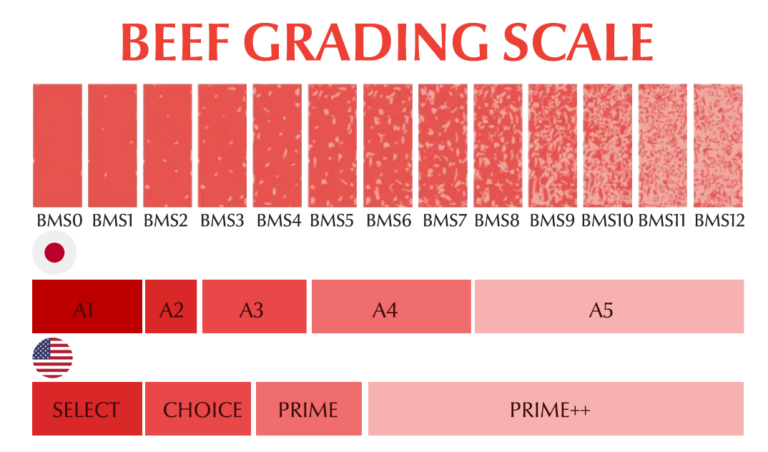
A Wagyu meat grading system has been developed by Japan Meat Grading Association (JMGA) to standardize the evaluation of meet, in order to ensure fair trading. The grades are classified by the basis of the yield grade and meat quality grade. The yield grade refers to the ratio of meat to the total weight of the carcass, and the meat quality grade is based on fat marbling, color, brightness, firmness and texture.

At WAGYU JAPAN, we specialize in only high quality marbled beef with grade A5 and A4.

A grade = Yield factor* over 72 point

*Yield factor = 67.37 + (0.130 x The area of the longest rib of the chest [cm2] ) + (0.667 x The thickness of belly [cm] ) – (0.025 x Cold carcass weight [Half-round carcass kg]) – (0.896 x Subcutaneous fat thickness [cm])

Marbling 5 = Quite a lot | BMS No. 8 ~ 12, Marbling evaluation criteria: Over 2+

Marbling 4 = Marbling 5 = Quite a lot | BMS No. 5~ 7, Marbling evaluation criteria: 1 + ~ 2

marbling grading chart
From JMGA (Japan Meet Grading Association) standard beef website

Japanese Wagyu vs. Angus

Marbling: One of the biggest differences between Japanese Wagyu vs. Angus is the quantity and pattern of marbling found in the meat. Japanese Wagyu is famous for the rich veins of marbling throughout the cut, while you’ll find that Angus has less marbling.
Texture: Thanks to the heavy marbling in Japanese Wagyu, the cut of meat is tenderer and buttery. And while Angus is still a tender cut, the lack of intramuscular fat marbling creates a cut that won’t melt in your mouth the way Japanese Wagyu beef does.
Flavor: Angus tends to have the signature beefy flavor that many associate with steak. Japanese Wagyu also has a beefy taste, but it’s much richer due to the amount of marbling. This isn’t to say Angus isn’t flavorful or rich — just that it’s easier to eat more Angus in one sitting than Japanese Wagyu, which many can only enjoy in smaller portions due to its richness. For this reason, Japanese wagyu is often served as small steaks or strips, while Angus is ideal for larger steaks and burgers. Either make fantastic gifts for steak lovers; it’s just a matter of whether the recipient would enjoy the once-in-a-lifetime richness of Wagyu or the full, beefy flavor of Angus.

Beef grading scale Wagyu vs Angus
Sign up for WagyuJapan Newsletter
Name
Shopping Cart
Scroll to Top